

Blog
Get Pay Right on ADP Workforce Now® Next Gen™
Bringing trusted compensation intelligence and seamless planning to even more ADP users.
Written by Salary.com Staff
December 26, 2025

Hiring the right people is getting harder as roles shift fast and skill needs to change almost overnight. This makes it tougher for teams to match talent to the work that actually needs to be done. A skills-based recruitment approach helps cut through that. It gives you a smarter, more flexible way to find great talent based on what people can do, not just what’s listed on their resume.
According to NACE research, almost 64.8% of employers already use skills-based recruitment for entry-level roles, and more than half rely on it most of the time. The study also shows that 90% use it during interviews and about two-thirds use it during screening, showing how common and practical this approach is.
In this guide, we’ll walk you through to show what skills-based hiring is, why it works, what you need to prepare, and how to build a process that gets better hires.
Skills-based recruitment is the process of hiring people based on what they can do, not on their college degree. Instead of relying on formal education requirements, hiring managers focuses on relevant skills needed for the job. This helps uncover qualified candidates who might get overlooked in the traditional hiring process.
Most of the time, these strong candidates come from different backgrounds or gain their skills through on-the-job learning or past experiences. This skills-based hiring approach also helps solve talent shortages and close skills gaps by widening the talent pool and attracting diverse talent who already have the critical skills needed for the role.
Tools like Salary.com’s JobArchitect make skills-based recruitment easier by helping teams build accurate, consistent, market-based job descriptions. With clearer skills data, hiring managers can focus on the exact skills needed for the role and quickly identify qualified candidates.
Hiring customer service representatives is a good example of skills-based recruitment in action. Instead of filtering candidates by a four-year degree, hiring managers focus on key skills like communication, problem-solving, critical thinking and tool familiarity. Someone with real hands-on experience often outperforms a new college graduate, helping teams hire faster, build a stronger talent pipeline, and future-proof critical roles.
Skills-based recruitment is changing the way companies hire. This approach shows that candidates have more to offer than what’s on paper. Skills and experience often matter more than formal credentials. But there are more reasons why skills-based recruitment can work in your favor. Here are some benefits of using skills-based approach:
Many strong candidates get overlooked because they don’t have the “right” degree, even if they have the exact skills needed for the job. A skills-based hiring approach evaluates real, demonstrated abilities gained through work experience, freelance projects, volunteer work, or self-learning. This helps hiring managers spot hidden talent and choose candidates who can contribute from day one.
Traditional hiring limits your search to people with certain degrees, but skills-based hiring opens the door to more qualified candidates with the right skills. By focusing on experience and real abilities, hiring managers can spot talent from different backgrounds. This helps fill roles faster, especially hard-to-fill positions where hands-on experience matters more than credentials.
A skills-based approach helps companies find talent with the necessary skills already in place, reducing the need for extra training. By evaluating a candidate’s skills, hiring managers get a clearer view of what they bring to the role and what the team is missing. This prevents hiring people who look good on paper but struggle with day-to-day tasks.
Skills assessments test the exact hard and soft skills required for the job, making it easier to predict how a candidate will actually perform. When you hire based on proven skills instead of degrees or GPAs, you get a more accurate picture of job readiness. This leads to better hiring decisions and stronger long-term performance.
Skills-based hiring attracts people who can adapt quickly, learn fast, and handle changing job demands. SHRM reports that many employers see better-quality hires when they use skills assessments in the hiring process. Over time, this approach builds a more resilient team that can take on new challenges and grow with the business.
But making the switch from traditional hiring practices cannot happen overnight. Here are the core things to prepare before you fully adopt skills-based hiring practices:
Clear and updated job requirements
You need a solid picture of what each role actually requires. This includes both the responsibilities and the skills needed to succeed. Clear job data keeps your hiring consistent and helps you evaluate candidates fairly. Tools like JobArchitect make this easier by helping you build structured, skills-aligned job descriptions.
A skills library or skills framework
Before you assess candidates, you need a list of the key skills tied to each job. This includes technical skills, soft skills, hard skills, and any role-specific abilities. A skills library keeps your hiring aligned and reduces guesswork.
Back-up from decision makers
Hiring managers, recruiters, and business leaders need to be on the same page. Everyone should understand why the shift matters and how it improves the quality of hires. Clear communication upfront helps the hiring process run smoother.
The Right Tools and Tech
Skills-based recruitment works best when supported by tools that help with job data, assessment, and evaluation. Whether you’re using skills assessments, HR tech, or platforms like JobArchitect for structured job posts, having the right systems keeps everything organized.
Now, its time to build a skills-based recruitment process that will work. This guide will help you set up a straightforward hiring process that focuses on the right skills.
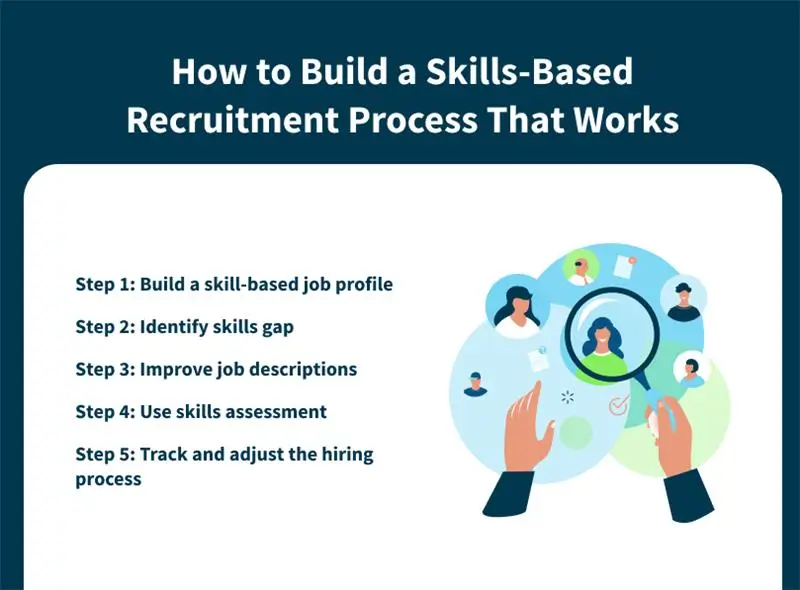
Start by clearly defining what each role needs in terms of responsibilities, tasks, and skills. Focus on both hard skills and soft skills. Having clear skills list upfront makes it easier to write better job descriptions, evaluate candidates fairly, and set the tone for your whole skills-based hiring approach.
Compare your current team or candidate pool against the job profiles you built. Look for missing skills that are critical for the role or future business needs. Rather than simply looking at the roles that need to be filled, HR should focus on the specific skills they are seeking. Identify which roles are hard to fill and why. This helps prioritize recruitment and training efforts.
After identifying the gaps, update your job descriptions. Remove unnecessary requirements and degree requirements. Start with the key skills needed for the role and avoid using power phrases. Well-crafted descriptions attract the right talent. For instance, instead of “bachelor’s degree required”, use “strong analytical thinking and hands-on experience with CRM tools.”
Start filtering your candidates by a skills assessment rather than looking at what’s on their resume. Include practical tests or work samples to evaluate candidates based on their skills. This ensures your skills-based process focuses on proven ability, not just credentials.
Hiring and onboarding new employees is not the end of the recruitment process. Hiring managers still need to track if the skills-based recruitment process works. How? Track retention, turnover, performance and productivity of the new hires.
Here are some questions related to skills-based recruitment:
Skills-based hiring focuses on what a candidate can actually do including their job-relevant skills and demonstrated competencies. Degree based hiring focuses on credentialsm degree or their educational background related to the job role. According to Indeed, skills-based approach broadens the talent pool and identifies strong performers who might not have traditional credentials.
In a skills-based interview, hiring managers typically ask behavioral and situational questions that probe how candidates have used the required skills in real-life scenarios. Based on How to Use Skills-Based Interview Questions to Evaluate Candidates, “Describe a time when you had to quickly adapt to a major change in your work environment.” or “Describe how you maintain the quality of your work under tight deadlines” are some examples of skills-based interview questions to assess candidates.
Some of the main challenges include the investment needed in reliable assessment tools, designing fair tests, and overcoming bias in evaluating non-traditional candidates. Indeed also note that shifting from degree filters to skill evaluation requires organizational change and buy-in.

The latest research, expert advice, and compensation best practices all in one place.
Blog
Bringing trusted compensation intelligence and seamless planning to even more ADP users.

Blog
Learn how to train managers for effective pay conversations and build trust.

Blog
Total rewards package flexibility lets employees choose what matters - pay, perks, and benefits tailored to their needs.