

Blog
Get Pay Right on ADP Workforce Now® Next Gen™
Bringing trusted compensation intelligence and seamless planning to even more ADP users.
Written by Salary.com Staff
December 26, 2025

Traditional payroll cycles are facing pressure. Younger workers are frustrated with waiting two weeks for pay, and 67% of U.S. employees think monthly or biweekly pay is outdated. More workers now expect faster access to their earnings.
At the same time, how pay periods are structured often depends on company size and industry. Larger companies usually pay biweekly, while smaller ones often pay weekly or semimonthly. Regardless of your current approach, reviewing your pay cycle helps ensure it meets both your workforce and business needs.
So how do you choose, especially now that employee expectations are shifting so quickly?
Salary.com defines pay period as "established specific time frame when employees receive their salary." In simple terms, it is the time during which an employee's work hours or salary are calculated for payment.
In the February 2023 release of the CES survey on the length of pay periods, it was revealed that 43.0% of U.S. private establishments reported paying employees biweekly (every two weeks). The next most common period is weekly (27.0%). Semimonthly (twice-a-month) pay schedules account for 19.8%, and monthly pay schedule is used by about 10.3% of private establishments.
However, recent surveys indicate trends that are shaping how employers may structure pay cycles in the future. In a 2024 Wages and Wellbeing study, a significant portion of working Americans reported "severe financial strain," and 82% of surveyed workers stated that same-day pay would improve their ability to save, meet monthly expenses, handle unexpected costs, and increase motivation and satisfaction at work.
A separate report also found that 83% of younger workers prefer daily access to wages rather than fixed paydays. These trends suggest a growing demand for pay flexibility, which employers can consider when designing payment schedules and benchmarking against industry standards.
A pay period calculator alone cannot solve payroll challenges. Organizations need solutions to manage pay periods accurately and meet employee needs. Salary.com's Compensation Planning Software helps calculate pay, generate HR reports, and update systems directly, which saves time and reduces errors.
When choosing pay periods for employees, it is critical for organizations to follow these considerations to ensure compliance, manage costs, and meet employee needs.
State and federal laws: Some states set rules on how often employees are paid, so knowing these requirements helps avoid penalties. For example, California requires most employees to be paid at least twice a month, and failure to comply can result in fines or legal action.
Fair Labor Standards Act (FLSA): Confirm that the cycle follows FLSA rules, especially overtime for nonexempt workers. The U.S. Department of Labor says employers must pay nonexempt employees 1.5 times their regular rate for any hours over 40 in a week, no matter the period.
Cash flow: Review how revenue comes in and choose a schedule that fits. Monthly paychecks fit a predictable end-of-month income, while biweekly needs steady cash reserves.
Business type: Industry norms affect pay schedules. A BLS survey revealed that construction and manufacturing often use weekly pay, education and health services, and leisure/hospitality favor biweekly pay, while information, finance, and professional services typically choose semimonthly or monthly pay.
Employee preferences: Knowing workforce preferences helps maintain satisfaction. Hourly workers often prefer more frequent pay, while salaried employees may be fine with less frequent pay periods. As mentioned, younger workers now tend to favor more frequent pay.
Payroll processing costs: Frequent pay cycles increase admin work and costs. Compensation Planning Software lets you handle salary planning in one place, including bonuses, merit increases, and other pay adjustments.
Pay periods can be weekly, biweekly, semimonthly, or monthly. Here are some common types, with their advantages and disadvantages:
Weekly pay period means a pay schedule where employees are paid once every week.
Pros: Employees get paid often, which can boost satisfaction
Cons: More payroll runs increase costs and administrative work
Biweekly pay schedule: Employees are paid every two weeks, often resulting in 26 paychecks per year.
Pros: Pay schedule is predictable and costs less than weekly
Cons: Paydays may vary each month and can make monthly budgeting harder for employees
Semimonthly pay cycle: Employees are paid twice a month, typically on fixed dates (e.g., the 15th and last day of the month).
Pros: Fixed pay dates help with monthly budgeting and reduce payroll work
Cons: Overtime calculations can be tricky for hourly employees, and longer gaps between paychecks may affect cash flow
Monthly pay period: Employees are paid once a month.
Pros: Lowest payroll costs and admin work; easy for accounting and budgeting
Cons: Long gaps between paychecks can strain employees' finances and reduce flexibility
Apart from these types, some employers also use a custom pay period, which can be a mix of different schedules or a combination of pay cycles that fits their needs.
The following examples show how different payroll periods work in practice:
Weekly
An hourly retail employee works Monday to Sunday each week. For the week of November 1 to 7, they submit their hours and are paid on Friday, November 12. The next paycheck covers November 8 to 14, paid on Friday, November 19.
Biweekly
A customer service representative is paid every two weeks on Friday. Their first cycle is November 1 to 14, and they are paid on Friday, November 19. The next pay cycle is November 15 to 28, paid on Friday, December 3.
Semimonthly
An administrative assistant is paid twice a month on the 15th and last day. Work from November 1 to 15 is paid on November 15, and work from November 16 to 30 is paid on November 30.
Monthly
A software engineer receives one paycheck per month, on the last day. Work performed from November 1 to 30 is paid on November 30, and work from December 1 to 31 is paid on December 31.
Organizations need to consider which pay period to choose, now that employee needs and payroll efficiency are more important than ever. Here are the steps to decide:
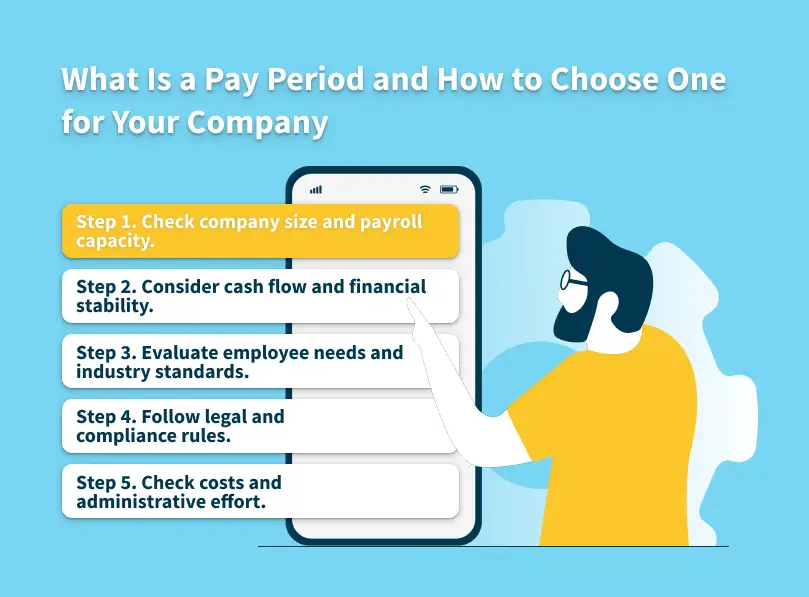
The size of a company often affects the best pay period. Large companies usually prefer biweekly or semimonthly pay to make payroll easier and reduce administrative work. Smaller companies may choose weekly or monthly pay based on their resources and payroll systems.
Choosing a cycle means understanding the company's cash flow. Weekly pay increases transactions and can strain finances if not managed carefully. Monthly pay lowers processing costs but may not match employee preferences.
Pay schedules impact employee satisfaction and competitiveness. Checking industry practices gives a benchmark, and asking employees shows their preferences. Many workers, especially hourly employees, prefer weekly or bi weekly pay period for easier budgeting and financial stability.
Federal and state labor laws set rules for timely wage payment and may limit the time between paychecks. Choosing a pay cycle must follow these rules to avoid penalties and ensure correct calculation of overtime, deductions, and benefits.
Payroll frequency impacts costs, such as processing fees, bank charges, and accounting work. It also affects employee satisfaction, retention, and errors. Considering these factors helps choose a pay cycle that balances efficiency, cost, and employee needs.
Speaking of administrative effort, Salary.com's Compensation Planning Software makes managing compensation and pay schedules easier. Its flexibility and customizability help reduce errors and save time.
Here are frequently asked questions about the topic:
The difference between a pay period and payday is that the former is the time during which work is tracked for payment, while the latter is the day employees actually receive their wages.
If you get paid every Friday, the period often ends the day before scheduled payday, which is Thursday. For example, if the employee's paycheck is on Friday, November 29, the pay period would typically cover Friday, November 15 through Thursday, November 28.
Not always. The term "per pay period" just means the amount earned during one period, but the length of that period depends on the company's schedule, such as weekly, biweekly, semimonthly, or monthly, so the actual timing and amount can vary.
The number of pay periods in 12 months depends on the pay schedule:
Weekly: 52 pay cycles per year
Biweekly (every 2 weeks): 26 pay cycles per year
Semimonthly (twice a month) : 24 pay cycles per year
Monthly: 12 pay cycles per year
It depends. If an organization wants to reduce payroll costs and administrative work, monthly pay may be better. If it wants to help employees with more frequent cash flow and budgeting, biweekly pay may be a better choice.
If an employee starts in the middle of a pay period, their pay is prorated for the days worked. Hourly employees are paid for hours worked, while salaried employees have their pay divided by the total days in the period and multiplied by days worked. For example, in a 30-day period, an employee starting on the 15th would be paid for the remaining 15 days.
Yes, a company can use different pay periods for different employees. For example, salaried staff may be paid biweekly, while hourly workers get paid weekly to match their needs. This can improve satisfaction but also makes payroll more complex. Reports show that having multiple pay schedules increases payroll challenges.
Complex payroll operations can lead to mistakes, and a typical payroll error costs $291 to fix. Yikes! To avoid costly errors, companies need accurate systems. Salary.com's Compensation Planning Software ensures precision by automating pay calculations and tracking all changes.

The latest research, expert advice, and compensation best practices all in one place.
Blog
Bringing trusted compensation intelligence and seamless planning to even more ADP users.

Blog
Learn how to train managers for effective pay conversations and build trust.

Blog
Total rewards package flexibility lets employees choose what matters - pay, perks, and benefits tailored to their needs.