

Blog
Get Pay Right on ADP Workforce Now® Next Gen™
Bringing trusted compensation intelligence and seamless planning to even more ADP users.
Written by Salary.com Staff
December 26, 2025

Establishing a fair and competitive compensation range is crucial for attracting and retaining top talent. In today’s competitive labor market, transparency around employees’ salary is not just a preference but an expectation. A well-defined salary range provides clarity for both employers and employees, setting the stage for trust and long-term satisfaction.
However, creating an effective compensation structure involves more than just picking a number. It requires careful market analysis, a clear compensation philosophy, and a deep understanding of your organization's financial position.
This guide will take you through what a compensation range is, why it matters, and how to create one that aligns with your business goals. We will also cover common mistakes to avoid, ensuring your approach is both strategic and sustainable.
A compensation range, often called a salary range or pay range, defines the minimum, midpoint, and maximum base salary an organization is willing to pay for a specific job or job grade. Its primary purpose is to provide a clear framework for making fair and competitive pay decisions. According to WorldatWork, 70% of organizations adjust their compensation ranges annually, highlighting their importance in a dynamic job market.
A compensation range guides how pay is determined based on factors like an employee's experience, skills, and performance. By establishing these boundaries, companies can ensure internal pay equity, manage their budget effectively, and remain competitive enough to attract qualified candidates.
The key elements of a compensation range are:
Minimum: The lowest salary for a position, typically reserved for new hires or those with limited experience.
Midpoint: The middle of the range, which usually represents the target market value for a fully proficient employee in the role.
Maximum: The highest salary for a position, often for employees with extensive experience and a track record of high performance.
For example, a compensation range for a role might look like this:
Minimum: $60,000
Midpoint: $75,000
Maximum: $90,000
This structure gives hiring managers and compensation professionals the flexibility to make appropriate salary offers and award raises while maintaining consistency across the organization.
Using compensation software from a provider like Salary.com can give you the data, tools, and confidence needed to get pay right. These platforms provide robust market pricing, simplify the creation of salary structures, and help you maintain internal pay equity, giving your organization a significant competitive advantage.
The width of a salary range often depends on the complexity and job level. Here are a few real-world examples to illustrate how they can vary:
1. Entry-level role: Customer Care Representative
Compensation range: $30,000 – $40,000 per year
Details: This role typically requires a high school diploma and basic communication skills. The narrow range reflects the defined scope of responsibilities and the large pool of available talent in the job market.
2. Skilled/technical role: Mid-Level Software Developer
Compensation range: $90,000 – $130,000 per year
Details: Requiring a bachelor's degree and 2-4 years of experience, this position commands a higher salary and a wider range. The spread allows for rewarding specialized skills and proficiency in high-demand programming languages.
3. Leadership role: Senior Marketing Operations Manager
Compensation range: $100,000 – $140,000 per year
Details: A senior leadership role with 7-10 years of experience has a wide compensation range to account for varying levels of strategic impact, team leadership responsibilities, and performance. This flexibility is key to retaining top executive talent.
While these terms are often used interchangeably, they represent different components of a company's compensation framework.
Salary range (or compensation range): This is the specific pay range (minimum, midpoint, maximum) for a single job or a group of similar jobs. It is the most granular element.
Salary grade (or pay grade): Meanwhile, salary grade is a level within a salary structure that groups together jobs of similar value and responsibility. For example, all entry-level administrative positions might fall into the same pay grade, meaning they share the same salary range. This simplifies compensation management for an organization with many jobs.
Salary structure: This is the complete framework that organizes all jobs and their corresponding salary grades within a company. It creates a hierarchy based on job levels and ensures that pay progresses logically as employees move up in the organization. Most companies (78%) use traditional salary structures with multiple grades, according to SHRM.
In practice, a company first defines its overall salary structure. Within that structure, it establishes multiple salary grades. Each salary grade is then assigned a specific salary range. This systematic approach ensures that pay decisions are consistent, equitable, and aligned with the organization's compensation philosophy.
Well-defined salary ranges are fundamental to attracting, retaining, and motivating the talent you need to succeed.
Here are the five steps to creating an effective compensation range:
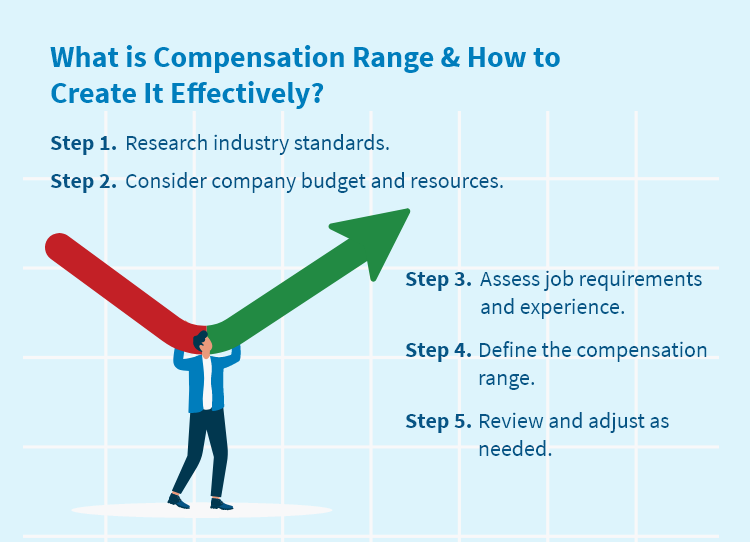
Start by gathering market data to understand what other companies in your industry and location are paying for similar roles. Use reliable sources like salary surveys and HR-reported data to benchmark your positions against the market. Compensation software can give you access to extensive datasets, allowing you to price jobs accurately.
Next, evaluate your company's financial health. Determine what you can realistically afford to pay while remaining competitive. Your compensation philosophy will guide this—do you aim to lead, match, or lag the market?
Analyze the responsibilities, skills, and experience required for each role. A senior-level position with complex duties will naturally have a higher salary range than an entry-level one. Differentiate roles based on their impact on the organization and the specific qualifications needed.
With your research and internal assessments complete, you can define the min, mid, and max for each salary grade. Salary.com’s compensation software with a drag-and-drop editor simplifies this step, allowing you to easily build and adjust salary structures. You can move jobs between grades and see the financial impact in real time.
Compensation is not a "set it and forget it" activity. Markets shift, and your business needs will evolve. Regularly review your salary ranges, at least annually, to ensure they remain competitive and aligned with your goals. Continuously monitor market trends and listen to feedback from recruiters and employees to make necessary adjustments.
Developing salary range manually can be complex and time-consuming. Compensation software streamlines this process, providing reliable market data and powerful modeling tools to ensure accuracy and efficiency.
Creating effective salary ranges is a detailed process, and several common mistakes can undermine your efforts.
Using outdated or unreliable market data: The job market changes quickly. Relying on old data can lead to uncompetitive pay ranges that fail to attract talent.
Setting ranges too narrow or too wide: A range that is too narrow limits your ability to reward high performers, while a range that is too wide can lead to inequities and budget issues.
Ignoring internal equity and pay compression: If you only focus on external market data, you risk creating pay disparities within your organization.
Failing to align ranges with compensation philosophy: Your salary ranges should be a direct reflection of your company's strategic decision on how to position pay against the market.
Not reviewing and updating ranges regularly: A "set it and forget it" approach does not work. Annual reviews are essential to keep your compensation structure competitive and relevant.
Here are some frequent questions about compensation range:
No, they are different. A compensation range is the specific pay band (minimum to maximum salary) for a particular job. A salary grade is a level in a company's pay structure that groups multiple jobs of similar value, which all share the same compensation range.
Several factors influence a salary range, including:
Market data: What other companies are paying for similar roles.
Job level and skills: The complexity, responsibilities, and required skills for the position.
Company size and industry: Larger companies or those in high-paying industries often offer higher salaries.
Location and cost of labor: Pay is often adjusted based on the cost of living in a specific geographic area.
Companies typically review their salary ranges annually. This process involves analyzing new market data to see how salaries have moved. Based on this review and the company's merit budget, they may adjust the entire salary structure to remain competitive. Economic factors and new regulatory requirements also play a role in these adjustments.
The width of a pay range often depends on:
Role complexity: Senior and executive roles have wider ranges to reflect a greater variance in impact and responsibility.
Company philosophy: Some companies prefer wider ranges (broadbanding) to provide more flexibility in pay decisions.
Job families: Roles with clear, linear career paths might have narrower ranges, while roles in dynamic job families might have wider ones.
Market competitiveness: In highly competitive job markets, wider ranges can help attract and retain top talent.

The latest research, expert advice, and compensation best practices all in one place.
Blog
Bringing trusted compensation intelligence and seamless planning to even more ADP users.

Blog
Learn how to train managers for effective pay conversations and build trust.

Blog
Total rewards package flexibility lets employees choose what matters - pay, perks, and benefits tailored to their needs.