

Blog
Get Pay Right on ADP Workforce Now® Next Gen™
Bringing trusted compensation intelligence and seamless planning to even more ADP users.
Written by Salary.com Staff
September 19, 2025
Generative AI (GenAI) is currently reshaping how many business functions operate, and human resources is one of the areas seeing the greatest impact. A recent Gartner study shows that the number of HR leaders either using or getting ready to adopt generative AI climbed significantly, increasing from 19% in June 2023 to 61% by January 2025.
Deploy the CompAnalyst AI Suite, and let Smart Agents match job, price roles, and build structure for you.
In this article, we will explore what generative AI in human resources is, how it works, its benefits, and practical steps HR professionals can take to adopt it effectively in their organizations.
Generative AI in HR refers to the use of artificial intelligence that focuses on producing new content by recognizing patterns from large datasets.
While traditional AI analyzes or predicts based on existing data, generative AI can generate original content such as text, images, code, or audio that closely reflects human-like creativity. In the HR function, this capability supports not only routine tasks but also more complex activities related to talent and performance management.
According to McKinsey's State of AI report, more than 78% of organizations are using generative AI in at least one function, with numerous companies revising workflows and assigning responsibility for AI governance directly to CEOs or boards to ensure it aligns with business priorities.
The impact of generative AI in human resources is commonly observed in four areas:
Content creation: Assisting in writing job descriptions, drafting candidate emails, and preparing training materials.
Data synthesis: Analyzing and deriving insights from unstructured data sources to improve performance management processes.
Communication: Supporting employee queries and onboarding new hires through generative AI chatbots.
Predictive coding: Anticipating attrition risks and supporting workforce planning.
By overseeing these HR functions, generative AI reduces the time spent on repetitive tasks, allowing HR professionals to dedicate more attention to strategic initiatives. Platforms like Salary.com’s human-centered AI enable organizations to leverage these capabilities to streamline HR processes and generate meaningful data-driven insights from HR data.
Generative AI works by using neural networks, including machine learning and large language models, to understand and recreate the structure of data, enabling them to generate original content rather than just classifying existing information. When given a prompt, these AI agents predict and generate new content, such as text, images, or sounds, based on what they have learned.
For example, GPT-3 is a language model that powers popular applications like ChatGPT. A user can type in a short request, and ChatGPT can produce a complete essay in response. Similarly, a model like Stable Diffusion is trained using a vast set of images, and it can generate new visuals that resemble those in the training data when given a text input.
Here are the benefits of generative AI in HR:
Improved efficiency and productivity: Generative AI automates repetitive and routine tasks, allowing HR teams to focus more on talent management, strategic initiatives, and overall organizational growth.
Real-time employee support: Generative AI chatbots provide 24/7 assistance by answering frequently asked questions and guiding employees, which reduces HR workload and improves employee satisfaction.
Improved employee engagement and retention: Generative AI uses performance data to create learning paths, predict turnover, and give managers tools to boost employee performance and measure employee sentiment.
Streamlined administrative tasks: Generative AI tools can automate routine processes, including benefits enrollment, compliance monitoring, payroll processing, and performance reviews, improving accuracy and reducing manual effort.
Cost savings: Using generative AI to reduce manual labor, speed up processes, and boost efficiency allows HR teams to lower operational costs and redirect budget to higher-value strategic activities.
Generative AI in HR is being applied across many functions:
Recruitment and hiring
When hiring new talent, generative AI in HR can help speed up the recruitment process. Business leaders and HR teams can use artificial intelligence to assist with talent acquisition and identify essential or specific skills needed for roles.
For example, gen AI tools like ChatGPT can help generate job descriptions and draft screening questions that match each role and candidate. This makes the interview process more efficient and focused.
Employee onboarding
Generative AI chatbots can act as virtual assistants for new employees, giving quick answers to questions about company policies, compensation, benefits enrollment, time off, and more. This support helps new hires settle in faster and makes the onboarding process smoother.
Training and development
Generative AI tools can customize employee learning by suggesting training resources tailored to individual skills, performance, and career objectives. This supports employee growth by ensuring that learning paths are relevant and practical.
For example, AI-based coaching tools are becoming popular because they provide real-time feedback, answer employee queries, and offer tailored insights.
Employee engagement and retention
A Gallup survey found that 51% of U.S. employees are looking for or open to new jobs, indicating a steady upward trend in turnover risk. But 42% of employees who voluntarily left their workplace said they might have stayed if their companies had made more effort to keep them engaged.
This highlights that employee engagement is critical for reducing turnover. Generative AI can assist human resources management in flagging early signs of turnover and suggesting strategies to re-engage employees, helping reduce attrition.
HR data analysis
Generative AI can review large amounts of HR data and highlight important patterns or problems that might otherwise be missed. It can also create easy-to-read reports and charts to share these findings.
For example, AI-powered HR analytics platforms can analyze salary data, attendance records, or performance reviews to spot issues like low morale or management challenges. They can also help write custom data queries for deeper analysis.
Internal communications
Generative AI can create communications that match a company’s values, voice, and tone. It helps write inclusive, personalized messages based on an employee’s role, interests, location, or career stage, ensuring clear and consistent messages for both job candidates and existing staff.
Companies looking to apply these capabilities can turn to generative AI platforms like Salary.com's business tool, which is designed to help HR teams work more efficiently and make better-informed decisions.
Now that you have a better overview of generative AI in human resources, here are five simple steps on how you can start using this tool in your workplace:
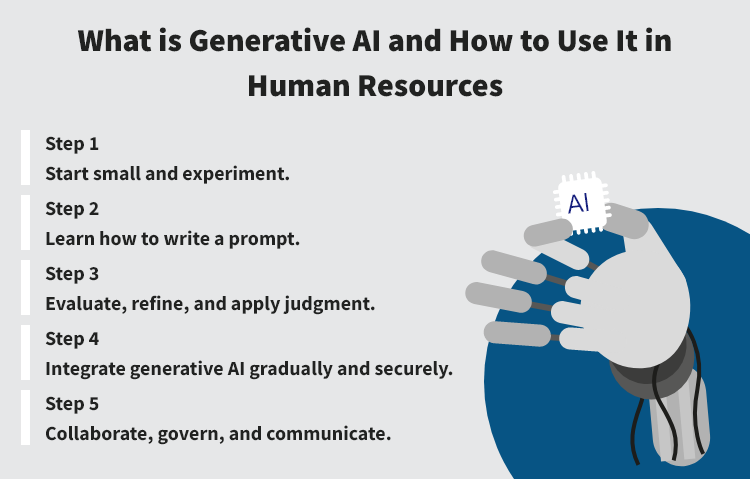
Use free generative AI tools like ChatGPT for simple tasks such as writing job descriptions, drafting emails, or creating survey questions. These small projects help you understand the technology’s potential without risking sensitive information or disrupting workflows.
Starting small also helps your team get comfortable with AI gradually. As you gain experience, you will be better equipped to identify where AI can add the most value in your HR processes.
Writing clear prompts is key to getting useful AI responses. This process is often called prompt engineering, which means making sure your prompt includes what you want to achieve (objective), relevant background (context), and how you want the information delivered (format).
For example: “Draft a job description for an HR Administrator covering responsibilities and benefits we offer.”
Try different ways of phrasing prompts to improve results. Small changes in wording or adding specific details can increase the accuracy of the output.
AI-generated responses are not perfect and should always be reviewed with a critical eye. Use your HR expertise to check whether the content aligns with HR processes, ethical considerations, and company policy. If the output is not right, adjust your prompt and run it again to improve the results.
This iterative process helps you learn how to craft better prompts and use AI more effectively.
Introduce AI into your workflow step by step, starting with less critical tasks like drafting policies or summarizing data. This gradual approach helps your team adapt smoothly and allows you to address any issues early.
Always keep data privacy in mind by protecting sensitive employee information and following relevant regulations. Consider creating a usage policy that clearly defines how AI should be used responsibly.
Work closely with your IT team to ensure generative AI integrates well with existing systems and operates smoothly. Their support also helps safeguard against technical problems and security risks.
Do not forget to implement governance measures to address bias and ethical concerns. Communicate openly with your team about AI’s role and offer training to help employees understand and use the tool effectively.
To put these steps into practice, consider leveraging specialized AI solutions designed for human resources, such as Salary.com's robust platform. This platform combines advanced generative AI capabilities with HR-specific data and insights, allowing your team to make data-driven decisions and focus on strategic HR initiatives.
Here are some questions about generative AI in human resources:
Generative AI is being used in human resources today to automate routine tasks like creating content, managing payroll, and analyzing data, while improving communication, onboarding, and employee experiences. This tool allows HR to focus more on strategic work.
The kind of content generative AI generates for HR includes job descriptions, recruitment emails, training materials, onboarding assistance, employee engagement surveys, personalized performance reviews, policy documents, and reports from HR data analysis.
Discover the CompAnalyst AI Suite, your all-in-one platform for data-driven decisions.
Some of the AI tools used in HR include GPT-4, which can create text like recruiting materials or email announcements; DALL-E, which generates images for newsletters or other written content; Lumen5, which turns information into short, easy-to-watch videos such as onboarding welcome videos; and Salary.com’s agentic AI, which helps HR teams handle tasks like analyzing salaries, tracking employee retention, forecasting market trends, and more.

The latest research, expert advice, and compensation best practices all in one place.
Blog
Bringing trusted compensation intelligence and seamless planning to even more ADP users.

Blog
Learn how to train managers for effective pay conversations and build trust.
Blog
Total rewards package flexibility lets employees choose what matters - pay, perks, and benefits tailored to their needs.