

Blog
Get Pay Right on ADP Workforce Now® Next Gen™
Bringing trusted compensation intelligence and seamless planning to even more ADP users.
Written by Salary.com Staff
December 26, 2025

In the world of hiring, understanding how effective your recruitment efforts are can make a big difference in finding the best talent. Yield ratio is an essential metric that helps track how many candidates move through each stage of the hiring process, from initial applications to final hires. By measuring this, organizations can spot bottlenecks and improve their recruitment strategies to attract more qualified candidates.
A study from the University of Illinois on recruiting intensity found that a one-standard-deviation drop in effort links to a 11.7% decrease in vacancy yield, emphasizing the need for focused strategies. This insight helps hiring teams adjust their approach, ensuring more yield ratios align with goals.
This guide is designed to break down the yield ratio in simple terms, showing how it fits into the recruitment process. It will help you calculate yield ratio and use it to boost recruitment efficiency, whether you're dealing with job boards, employee referrals, or recruitment agencies.
Yield ratio refers to the percentage of candidates who advance from one stage of the hiring process to the next, providing clear insight into recruitment effectiveness. Ensuring compliance with wage requirements can help prevent early-stage drop-offs. Minimum Wage Data provides current and accurate wage information, supporting organizations in maintaining a strong candidate flow through each stage of hiring.
It's a keyway to measure how well your efforts turn applicants into hires, helping identify areas where selection ratios decrease or where you might need better screening techniques.
Basic definition: Yield ratio is calculated as the number of candidates progressing to the next stage divided by the total number at the current stage, multiplied by 100.
Why it matters: Tracking selection ratios gives data-driven insights into the hiring pipeline, revealing if a low yield ratio signals issues like potential bias in resume screening or mismatched position requirements.
Example: If 100 applicants apply via a job board and only 20 make it to the screening call stage, that's a 20% selection ratio, indicating room for improvement in initial screening processes.
Yield ratio offers a snapshot of how efficient your recruitment is at each step, from sourcing to onboarding.
It helps compare recruitment ratios across different recruitment channels, like internal employee referrals versus external recruiters, to find what delivers the most qualified candidates.
Monitoring recruiting selection ratios can lead to significant cost savings by pinpointing low yield areas, such as a particular source with few solid candidates resulting. Using Job Range Wizard can help HR teams define competitive job levels and pay ranges, improving candidate attraction and conversion.
It acts as one of the key performance indicators for HR professionals, allowing them to refine effective recruitment strategies and increase efficiency in filling vacant positions.
A good yield ratio signals strong candidate quality, while a high selection ratio might indicate overly lax selection criteria, and a low yield could point to overly strict screening call phases.
By analyzing yield metrics, hiring teams gain a strategic advantage in attracting the best candidates and reducing time to hire.
The yield ratio formula is a straightforward way to quantify progress in the recruitment stage, turning raw numbers into actionable percentages.
Core formula: Yield ratio = (Number of candidates advancing to next stage / total number of candidates at current stage) × 100.
Application: Use this to calculate the yield ratio for specific parts, like from screened candidates to interviewed candidates. Tracking progression from screening to interview becomes more reliable when supported by Job Matching, which aligns candidates with appropriate roles.
Variations: For overall recruiting yield ratios, sum up across stages to see the recruitment yield pyramid, showing how many candidates you need at the top to get hires at the bottom.
Insights: This formula helps identify if yield ratios decrease due to factors like interest rates affecting job market dynamics or poor candidate source matching.
Using the formula (Number advancing / total at current stage) × 100:
Application to screening: (100 screened / 500 applications) × 100 = 20%. This suggests one in five applicants meets basic qualifications.
Screening to interview: (25 interviewed / 100 screened) × 100 = 25%. Here, a quarter progress, possibly due to skill assessments.
Interview to offer: (5 offers / 25 interviewed) × 100 = 20%. This ratio might reflect competitive evaluations.
Offer to hire: (2 hires / 5 offers) × 100 = 40%. A lower acceptance could indicate issues with compensation or candidate fit.
These calculations provide data-driven insights, showing an overall funnel where 500 start and 2 end, for a cumulative yield of 0.4% from start to finish.
Calculating yield ratio involves breaking down the hiring process into stages and applying simple math to see where improvements are needed.
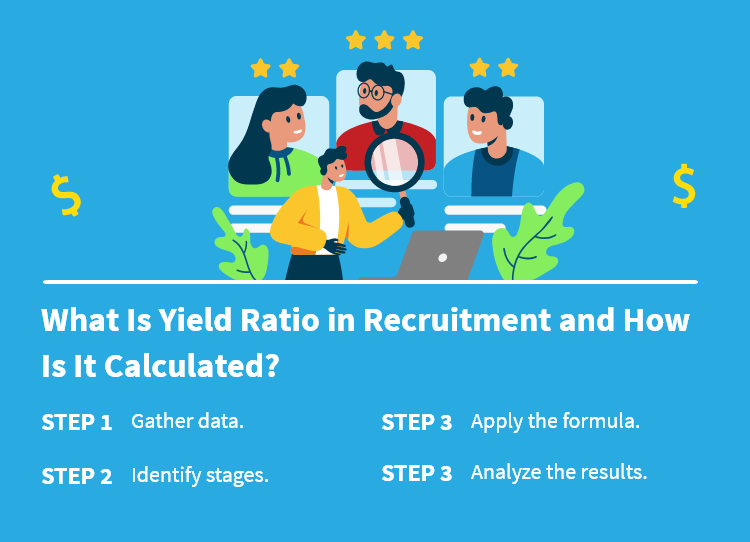
Collect the total number of candidates at each recruitment stage, such as applications received from various sources like recruitment agencies or job boards. This ensures you have accurate figures for how many candidates enter the initial screening process.
Define key points like the screening call stage, interview stage, and offer phase to track progress. Focus on one stage at a time to calculate yield and spot where more candidates drop off.
Divide the number advancing by the starting number in that stage, then multiply by 100 for the percentage. This gives clear insight into recruitment efficiency and helps compare recruitment ratios.
Review if you have a high yield ratio indicating quality candidates or a low selection ratio suggesting better screening techniques or changes in external agency's services.
Here's are some FAQs for better understanding:
The 70 rule of hiring suggests aiming for a 70% yield in certain stages to balance efficiency and quality, meaning about 70% of candidates should advance if your process is optimized. This rule helps HR professionals avoid overly stringent filters that might exclude solid candidates while ensuring the interview process focuses on the most qualified candidates.
A dividend yield trap occurs when a stock's high yield ratio looks appealing but signals underlying issues like declining company health or unsustainable payouts. Investors fall into this by chasing high yields without checking fundamentals, often leading to losses as share prices drop.
A 2% yield means an investment returns 2% annually based on its current price, such as dividends for stocks or interest for bonds. This low yield might indicate a stable but low-growth asset, especially in environments with rising interest rates, where safer options could offer similar returns with less risk.

The latest research, expert advice, and compensation best practices all in one place.
Blog
Bringing trusted compensation intelligence and seamless planning to even more ADP users.

Blog
Learn how to train managers for effective pay conversations and build trust.

Blog
Total rewards package flexibility lets employees choose what matters - pay, perks, and benefits tailored to their needs.