

Blog
Get Pay Right on ADP Workforce Now® Next Gen™
Bringing trusted compensation intelligence and seamless planning to even more ADP users.
Written by Salary.com Staff
October 17, 2025
The question "Will HR be replaced by AI?" has become increasingly prevalent as artificial intelligence transforms workplace operations. Recent SHRM research reveals that nearly half of human resource professionals report that using AI to support HR has become a priority in the past year, with about 1 in 4 organizations currently using AI for HR-related activities.
However, the reality is more nuanced than complete replacement. Will AI replace HR entirely? The answer is no. Instead, AI will fundamentally transform how HR professionals work, shifting their focus from routine administrative tasks to strategic, human-centered activities that require empathy, creativity, and complex decision-making.
Understanding this transformation is crucial to empower HR professionals who want to remain relevant and valuable in an AI-driven workplace. This guide explores which HR functions AI can automate, which require human expertise, and how HR executives can successfully navigate this evolution.
AI adoption in human resource management has accelerated dramatically over the past decade. What began with basic automation tools has evolved into sophisticated systems capable of screening resumes, conducting initial interviews, and predicting employee retention risks.
Current AI tools in HR include recruitment bots that can process thousands of applications, payroll automation systems that reduce manual errors, and analytics dashboards that provide real-time insights into employee engagement. Major companies like Walmart use internal AI assistants to help HR teams access key metrics instantly, while platforms like HireVue analyze video interviews to assess candidate suitability.
Market trends indicate continued growth in AI adoption across HR departments. The technology, finance, and information industries lead in implementation, with the largest organizations (5,000+ employees) showing the highest adoption rates. This trend reflects AI's ability to handle the complexity and scale that large organizations require.
As the debate over “will HR be replaced by AI” continues, it’s clear the technology offers both opportunities and challenges. AI in HR provides significant benefits while also creating new concerns that HR professionals must address.
Will AI replace HR? Artificial intelligence will likely automate or significantly reduce the need for certain HR roles, particularly those involving routine, data-intensive tasks:
AI in HR will affect administrative coordinators who handle repetitive tasks like scheduling, data entry, and basic employee inquiries.
Initial screening specialists whose primary role involves reviewing resumes and conducting preliminary assessments.
Benefits enrollment assistants who guide employees through standard benefit selection processes.
Basic compliance tracking roles that monitor routine regulatory requirements.
Entry-level recruiting coordinators who perform candidate sourcing and initial outreach will also be impacted by AI in HR.
These positions face displacement because AI solutions can perform these tasks faster, more accurately, and at lower cost than human workers.
Several HR functions require a uniquely human element that artificial intelligence cannot replicate:
Strategic HR leadership that involves complex decision-making, organizational culture development, and long-term planning.
Employee relations specialists who handle sensitive workplace conflicts, grievances, and disciplinary actions.
Change management consultants who have deep understanding and guide organizations through transitions and cultural transformations.
Executive coaching and development roles that require deep emotional intelligence and personalized guidance may not be impacted by AI in HR.
Crisis management specialists who navigate complex workplace incidents requiring discretion and empathy.
Diversity, equity, and inclusion professionals who address systemic issues and build inclusive cultures.
These roles remain secure because they require human interaction, emotional intelligence, ethical judgment, creative problem-solving, and the ability to build trust and relationships—capabilities that remain uniquely human.
Rather than asking will AI replace HR, know that technology like that of Salary.com’s AI tool will transform human resources through a systematic evolution of roles and responsibilities.
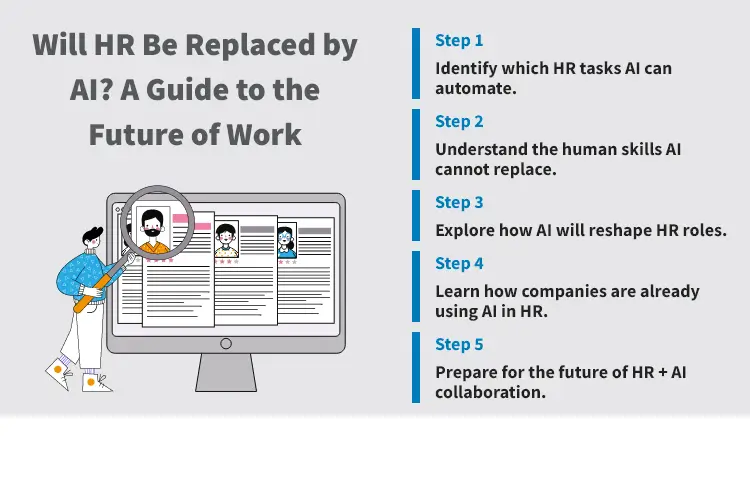
HR professionals should begin by auditing their responsibilities to identify tasks well-suited for automation. These often include data entry and record keeping, resume screening and candidate ranking, and scheduling interviews. Basic employee inquiries about policies and procedures can also be automated, along with routine compliance reporting, performance review data compilation, and benefits enrollment processing. By targeting these areas, HR can reduce manual workload and redirect time toward more strategic initiatives.
Focus on developing and leveraging capabilities that remain exclusively human:
Emotional intelligence for understanding and responding to complex human emotions.
Strategic thinking that considers long-term organizational implications.
Creative problem-solving that generates innovative solutions to unique challenges.
Relationship building through transparent communication that establishes trust and rapport with employees.
Ethical decision-making that navigates complex moral and legal considerations.
Cultural sensitivity that adapts approaches to diverse workplace environments.
Move on from the notion of “will HR be replaced by AI” and focus on the fact that AI will transform existing roles rather than eliminate them entirely:
With AI in HR, recruiters will evolve from resume reviewers to talent strategists who focus on cultural fit and long-term potential for talent acquisition.
HR generalists will become strategic advisors who use AI-generated insights to make complex informed decisions.
Learning and development specialists will design personalized growth experiences based on AI-identified skill gaps for better career goals.
Compensation analysts will interpret AI-generated market data to create equitable pay structures with the use of tools such as Salary AI.
Study successful AI implementations to understand practical applications:
SingleStore embeds AI into role design and candidate matching to accelerate hiring decisions.
Perceptyx employs AI-powered knowledge bases to provide quick answers to employee queries.
Walmart pilots AI-powered interview coaching to help employees improve their career prospects.
HR professionals should build the skills and strategies needed to collaborate with AI systems. This includes learning to interpret and act on AI-generated insights, gaining proficiency with tools relevant to their HR specialization, and focusing on areas where human judgment adds the most value while letting AI handle data-heavy tasks. AI in HR should also strengthen their understanding of AI ethics and bias detection to ensure responsible use, while cultivating strategic thinking skills that enhance and complement AI’s analytical capabilities.
Real-world implementations demonstrate AI's practical impact across HR functions:
Walmart's My Assistant: An internal AI chatbot loaded with company knowledge helps HR associates access key metrics instantly and answer common employee questions, enabling a self-service model that frees up time for strategic work.
HireVue's video analysis: This platform analyzes video interviews using AI to provide insights into candidates' skills, behavior, and cultural fit, accelerating the recruitment process by identifying top candidates early for faster hiring.
Eightfold.ai's Talent Matching: Uses deep learning to match candidates to jobs based on skills and career trajectories while identifying skill gaps and suggesting upskilling opportunities for current employees.
IBM Watson's predictive analytics: Provides HR teams with advanced analytics for recruitment, engagement insights, and people management planning, enabling data-driven decision-making across multiple HR functions.
Pymetrics' bias-free assessment: Uses neuroscience-based assessments and AI to evaluate candidates' cognitive and emotional traits through game-based evaluations, reducing hiring bias while improving candidate-role matching.
Visier's workforce analytics: Offers predictive analytics that help HR leaders anticipate workforce needs, identify retention risks, and develop targeted strategies based on comprehensive employee data analysis.
Workday's comprehensive AI suite: Integrates AI across talent management, payroll, and workforce analytics, providing personalized insights that help HR departments align employee growth with organizational goals.
Here are some frequent queries relating to the questions, will HR be replaced by AI?
AI will transform HR from a primarily administrative function to a strategic business partner. HR professionals will shift from routine tasks like data entry and screening to strategic work such as workforce planning, culture building, and employee relations, with a stronger focus on analyzing AI insights to guide decisions.
HR professionals should not fear complete replacement but should prepare for significant role evolution. While most people still ask “will AI replace HR” out of fear, that is not the whole story. AI may handle routine tasks, but it can’t replace human skills like empathy, strategy, relationships, and ethics; HR professionals who strengthen these while adapting to AI will stay indispensable.
HR departments will become highly data-driven organizations that use AI as a powerful tool for operational efficiency while focusing human expertise on strategic initiatives. AI will automate tasks like screening, scheduling, and inquiries, while HR shifts to strategic advising on talent, development, and workforce planning.
No, AI cannot perform all HR manager functions. AI handles data and routine tasks, but it can’t replace human strengths like empathy, ethics, relationships, and cultural leadership; HR’s future lies in blending AI insights with human expertise.

The latest research, expert advice, and compensation best practices all in one place.
Blog
Bringing trusted compensation intelligence and seamless planning to even more ADP users.

Blog
Learn how to train managers for effective pay conversations and build trust.
Blog
Total rewards package flexibility lets employees choose what matters - pay, perks, and benefits tailored to their needs.